
Paradise Lost: The Disappearance of the Embodied North
- AT

- Jun 21
- 11 min read
As this essay is published on the Summer Solstice—the longest day of the year in the Northern Hemisphere—it is worth noting that few celebrations remain as closely associated with Scandinavia as Midsummer. Across Sweden, Finland, Norway, and other Nordic countries, families continue to gather outdoors to celebrate the arrival of summer. Flower crowns, maypoles, lakeside gatherings, swimming, and long evenings beneath the lingering northern sun remain enduring symbols of Nordic life. Yet these traditions also serve as reminders of an older relationship between human beings, nature, and the body—one that has changed considerably over the past century.

In previous essays, including Constructing Shame, On Childhood, Nature, and Freedom, The Social Construction of Danger, and The Child Who Forgot They Had a Body, I explored a number of developments that at first appear unrelated. I examined the decline of outdoor childhood, the rise of screen-based living, changing attitudes toward the body, increasing concern over risk and safety, and the growing tendency to experience the world through mediated forms of interaction. Taken individually, these developments might appear to be separate social trends. Viewed together, however, they reveal a broader transformation in how modern societies relate to the world, to nature, and to the body itself.
Few places illustrate this transformation more clearly than Scandinavia.*
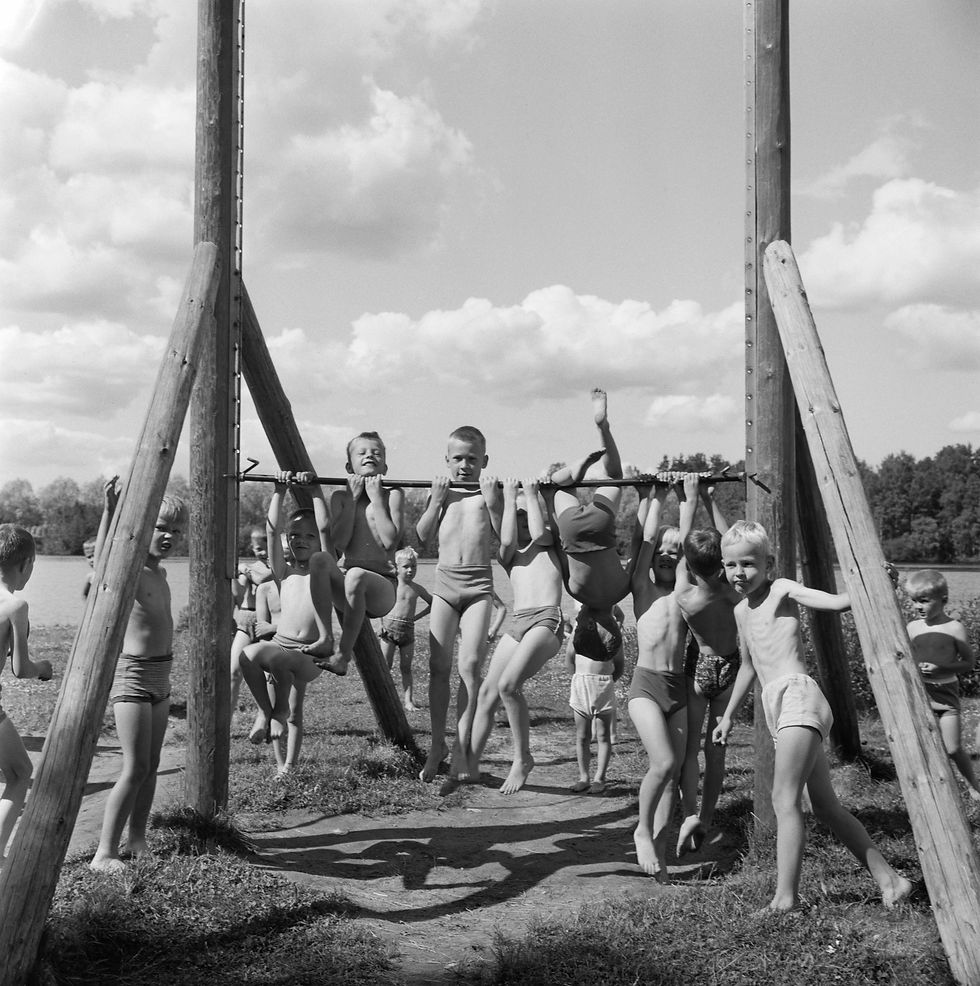
Within living memory, Scandinavia was widely associated with outdoor childhoods, strong traditions of friluftsliv (open-air life), high levels of independent mobility among children, communal recreation, family bathing, and a comparatively relaxed attitude toward the human body. Today, many of those same societies increasingly resemble other highly mediated Western cultures. Children spend more time indoors. Outdoor play has declined. Bodies attract greater scrutiny. Risk management occupies a more prominent role in everyday life.
The question is not merely what changed. The question is why.
The Embodied North
Historically, Scandinavian societies developed under conditions that encouraged close engagement with the natural world. For centuries, forests, lakes, coastlines, mountains, and seasonal cycles shaped daily life. Even as industrialization transformed the region during the nineteenth and twentieth centuries, this relationship remained unusually strong.
Perhaps no concept captures this orientation better than friluftsliv, a term often translated as “open-air life.” Popularized by the Norwegian playwright Henrik Ibsen and later embraced throughout Scandinavia, friluftsliv represented far more than outdoor recreation. It expressed a philosophy of direct engagement with nature, simplicity, self-reliance, and physical presence in the world (Gelter, 2000).
To contemporary observers, it is easy to mistake such traditions for leisure activities. Historically, however, they were woven into everyday life. Children played outdoors because there was little reason not to. Families swam in lakes because lakes were everywhere. Summer cottages, forest excursions, berry picking, hiking, fishing, skiing, and boating were not specialized hobbies, but ordinary experiences shared across social classes.
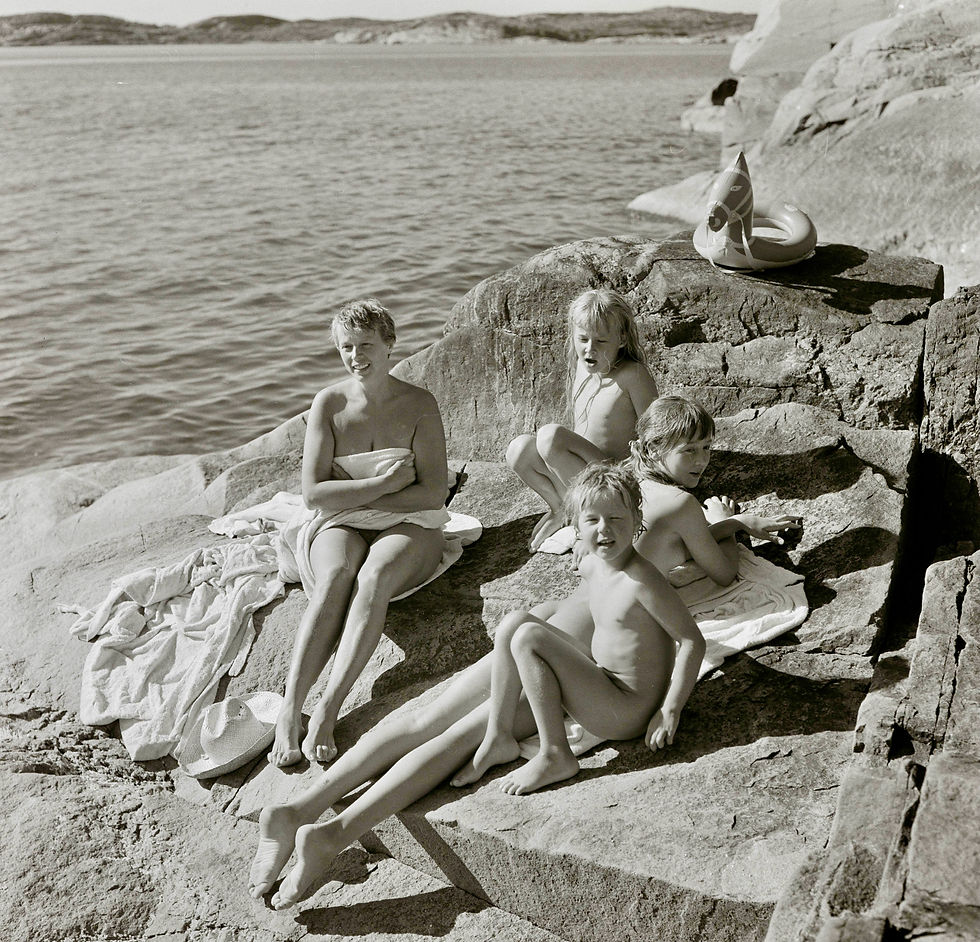
Importantly, these activities cultivated what might be described as an embodied relationship with the world.
Children learned through movement. They climbed rocks, balanced on fallen trees, rowed boats, explored islands, built forts, and developed practical competencies through direct interaction with their surroundings. Their bodies were not primarily objects of observation or evaluation. They were instruments through which experience occurred.
This distinction is significant.
As discussed in The Child Who Forgot They Had a Body, healthy childhood often involves periods in which attention is directed outward toward the world rather than inward toward constant self-monitoring. Much of traditional Scandinavian childhood was structured around precisely these kinds of experiences.

Childhood in the Scandinavian Imagination
The assumptions underlying this way of life are visible throughout Scandinavian literature, art, and film.
Astrid Lindgren's stories provide perhaps the most famous examples. Whether in The Children of Noisy Village, Emil of Lönneberga, Pippi Longstocking, or Ronia, the Robber's Daughter, children are depicted as active participants in the world rather than passive recipients of adult supervision. They climb trees, navigate forests, row boats, build hideouts, and solve problems independently.
To modern audiences, these stories often appear charming or nostalgic. Yet Lindgren was not describing a fantasy world. She was depicting a version of childhood that many Scandinavian readers recognized from their own lives.
The same assumptions carried over into film and television adaptations. Children ran barefoot through forests, swam in lakes, changed clothes outdoors, and spent extended periods beyond direct adult supervision. These scenes rarely attracted attention because they were not intended to communicate anything unusual.
They were intended to communicate childhood.

What is particularly revealing is that many modern viewers interpret these same scenes differently. Activities that earlier audiences regarded as ordinary are now more likely to be viewed through the lens of safety, propriety, or bodily exposure.
This shift in interpretation tells us something important.
The practices themselves are only part of the story. Equally significant is the change in meaning attached to them.
The School Swimmer
Few examples illustrate this transformation more clearly than swimming instruction.
Throughout much of the twentieth century, swimming was regarded as an essential life skill across Scandinavia. Given the region's abundance of lakes, rivers, and coastlines, water competence was not merely recreational but practical.
Municipal pools, public bathing facilities, and school swimming programs became common features of public life. Historical photographs, educational films, and newsreels frequently depict children participating in swimming instruction under conditions that contemporary audiences often find surprising.
In some contexts, boys swam without clothing. Such scenes appeared openly in educational materials and public documentation. What is striking, however, is not the practice itself but the absence of commentary surrounding it.

The purpose of these films was not to discuss nudity. They were concerned with health, education, physical competence, and water safety. The body appeared because swimming required a body. Beyond that, it attracted little attention.
Today, many viewers notice the nudity first and the activity second. Historically, people often noticed the activity first and the body second. That reversal reveals a profound cultural shift.
As argued in The Social Construction of Danger, dangers are not simply discovered. They are interpreted through social narratives and cultural assumptions. What changed was not the human body itself but the meaning attached to it.

Sauna, Bathing, and the Ordinary Body
The Scandinavian relationship with the body was also expressed through traditions of bathing and sauna culture, particularly in Finland but also throughout much of the Nordic region.
For centuries, the sauna occupied a central place in Finnish life. It functioned not merely as a recreational activity but as an institution woven into everyday existence. People bathed, relaxed, socialized, and conducted important family rituals within the sauna. Historically, births were sometimes attended in saunas because they were among the cleanest and warmest spaces available. Families gathered there across generations, and the experience was understood primarily through the lenses of hygiene, health, and community rather than sexuality (Miettinen, 2019).
What is particularly relevant is the degree to which the body remained ordinary within this context.
In contemporary discussions, nudity is often assumed to carry inherent symbolic significance. Yet in traditional sauna culture, the body was frequently stripped of much of the meaning modern societies attach to it. The sauna was not intended to display the body, celebrate the body, or make statements about the body. Rather, it created an environment in which the body could simply exist without attracting unusual attention.

A similar pattern could be found in public bathing facilities, summer cottages, lakeside swimming, and changing areas throughout Scandinavia. While practices varied considerably across regions and decades, these settings often reflected a broader cultural distinction between ordinary bodily presence and sexuality.
This distinction helps explain why many historical photographs, films, and family records from Scandinavia appear surprising to contemporary audiences. The issue is not that earlier generations placed greater emphasis on nudity. In many cases, they placed less emphasis on the body altogether.
The body was present because human beings have bodies.
Beyond that, it often required little interpretation.
From the perspective of embodiment, this is significant. A society in which bodies can appear without becoming the center of attention is fundamentally different from a society in which bodies are constantly scrutinized, evaluated, or interpreted through moral, sexual, or political frameworks.

The contrast becomes particularly visible when comparing traditional sauna culture with contemporary digital culture. Historically, people encountered bodies directly and in ordinary contexts. Today, people encounter bodies increasingly through screens, advertising, social media, and commercial imagery. The body has become less familiar as an everyday reality and more familiar as a representation.
This transformation mirrors the broader shift discussed throughout this essay. The embodied North was characterized by direct experience. The mediated world increasingly replaces experience with images.
Trust, Freedom, and Risk
Another factor contributing to traditional Scandinavian childhood was unusually high levels of social trust.
For much of the twentieth century, Scandinavian societies consistently ranked among the highest-trust societies in the world. Children were allowed greater freedom not simply because parents were less concerned, but because communities generally expected neighbors, teachers, and other adults to contribute to a shared social environment.
This trust enabled forms of independence that have become less common today.
Children walked to school alone. They visited friends without constant coordination from parents. They explored local neighborhoods, forests, and waterways with comparatively little supervision.
Research on childhood mobility suggests that independent movement has declined significantly across much of the developed world since the latter half of the twentieth century (Gill, 2007; Gray, 2011).
The consequences extend beyond logistics. When childhood becomes increasingly supervised, opportunities for experimentation, competence-building, and embodied learning also diminish.

The Great Shift
Beginning in the second half of the twentieth century, several developments began to reshape Scandinavian society.
The first was the emergence of what sociologist Ulrich Beck (1992) described as the "risk society." Increasing attention was devoted to prevention, safety, liability, and expert management. Childhood gradually became a project to be supervised rather than a stage of life in which competence was acquired through direct experience.
The second was the growing influence of international media, particularly American media. Hollywood films, television programs, advertising campaigns, and later digital platforms introduced cultural assumptions that often differed from traditional Scandinavian attitudes regarding childhood, sexuality, and the body.

As discussed in Exporting Shame: The Americanization of Public Nudity Norms in Europe, this influence did not simply promote new forms of entertainment. It also promoted new ways of interpreting bodies, risk, and propriety.
Americanization, however, was only one part of the story. Television itself altered daily life. Later, computers, smartphones, and social media transformed how people interacted with information, recreation, and one another. Increasingly, experience became mediated through screens.
The child who once explored forests now explored digital worlds.
The child who once learned through physical experimentation increasingly learned through representation.
The child who once forgot about their body increasingly encountered environments that encouraged constant self-monitoring and comparison.
From Embodied Life to Mediated Life
Many discussions of cultural change focus on whether people wear more or less clothing than previous generations. This is ultimately a secondary question.
The more important issue concerns attention.
The Scandinavia of the mid-twentieth century was not a society obsessed with nudity. It was a society in which the body often occupied a less prominent place in consciousness.
Children swam, climbed, explored, rowed, hiked, and played. The body was visible because life was physical, but it was never the center of attention.

Contemporary society presents a striking contrast.
Children encounter unprecedented numbers of images, representations, and opportunities for self-monitoring. Social media encourages comparison. Digital platforms reward visibility. Bodies are less frequently encountered in ordinary contexts and more frequently encountered as images.
Paradoxically, the body has become less visible in everyday life while becoming more psychologically salient.
What disappeared, therefore, was not simply a collection of practices.
It was a particular relationship between people, their bodies, and the world around them.
Paradise Lost?
The disappearance of barefoot summers, communal changing rooms, unselfconscious swimming lessons, outdoor childhoods, and ordinary bodily ease is often interpreted as a story about nudity.
In reality, it is a story about attention. The Scandinavia of the mid-twentieth century was characterized by a culture in which experience mattered more than appearance, participation mattered more than observation, and direct engagement mattered more than mediation.
The transformation of Scandinavian society cannot be reduced to a single cause. Risk consciousness, global media, digital technology, changing concepts of childhood, declining social trust, and shifting perceptions of the body all played a role. Yet the cumulative effect has been profound. A culture once oriented toward direct experience became increasingly mediated.

Understanding that transformation matters not because the past should be romanticized, but because it reminds us that alternative ways of living are possible. The historical record demonstrates that a society can foster independence, outdoor life, bodily ease, and deep engagement with nature without turning those practices into ideological statements.
For much of Scandinavian history, they were simply part of everyday life. Arguably, they were healthier practices than today’s hypersexualization and scrutinization of human bodies. As argued elsewhere, when we tell our children they must hide their bodies from others, we teach them that they are objects of desire, potential fomenters of danger, rather than the innocent non-sexual beings they are. For our children’s sake, we should refuse to give in to these modern norms, this robbery of our children’s innocence, and this harmful path towards human isolation and gymnophobia.
Astrid Lindgren’s world was fiction but many of her stories were based on true experiences. And her stories are not pure nostalgia – she also showed the extreme poverty and inequalities that plagued Swedish society in the early 20th Century. The point is not to “go back” to some kind of idealized past, but rather to salvage that which was wholesome and good.
All is not lost; it is not too late to wake up. In fact, there are many parents who refuse to participate in the hypersexualization of their children and allow them the freedom to be just that – children. Together, as a Community, we can change these norms and once again allow our children to feel connected to something bigger than themselves. To feel that they are part of every living thing on Earth without shame and superficial concerns with their bodies.
* For simplicity, this essay uses the term “Scandinavia” in its broader popular sense, encompassing the Nordic countries. While Finland is not technically part of Scandinavia in the linguistic and historical sense, many of the cultural developments discussed here—including traditions of outdoor life, childhood independence, public bathing, and embodied engagement with nature—are shared across the Nordic region.
References
Beck, U. (1992). Risk Society: Towards a New Modernity. London: Sage.
Edensor, T. (2006). "Sensing the Ruin." The Senses and Society, 1(1), 39–56.
Gelter, H. (2000). "Friluftsliv: The Scandinavian Philosophy of Outdoor Life." Canadian Journal of Environmental Education, 5, 77–92.
Gill, T. (2007). No Fear: Growing Up in a Risk Averse Society. London: Calouste Gulbenkian Foundation.
Gray, P. (2011). "The Decline of Play and the Rise of Psychopathology in Children and Adolescents." American Journal of Play, 3(4), 443–463.
Miettinen, A. (2019). Sauna: Cultural History of the Finnish Sauna. Finnish Literature Society.
Putnam, R. D. (2000). Bowling Alone: The Collapse and Revival of American Community. New York: Simon & Schuster.
Twenge, J. M. (2017). iGen. New York: Atria Books.


As a Swede, I feel this one resonates a lot. Things are so different from when I was a kid, not that long ago. I grew up at a time when it was perfectly normal to either change openly on the beach or simply swim naked, it wasn't a big deal. We also showered after PE class, which is not something my boys get to do here in the US, it's disgusting. Kids are not taught proper hygiene in school if they sweat for an hour in their regular clothes, then go back to other classes without showering. Kids here are completely unaware of non-sexual nudity - anything naked is sexual to them. It is not a healthy path.