
The Body Revealed: Nakedness, Innocence, and the Religious Imagination
- AT

- Jan 24
- 7 min read
Updated: Feb 21
Many of us assume that religion has always regarded the naked human body with suspicion, and that modesty – understood as concealment – flows naturally from faith itself. Within this frame, nudity appears as a moral problem waiting to happen, especially where children are concerned. Yet this assumption collapses under even modest historical scrutiny. Across religious traditions, nakedness was not originally treated as obscene, dangerous, or corrupting. Shame entered later, shaped by social anxiety, power, and fear – not divine necessity.

Whether or not you are a person of faith, this article focuses on religious constructions of the naked body and helps explain why we in the Community insist that our philosophy is non-denominational and provides a philosophical framework for believers and non-believers alike.
This essay continues the work begun in Constructing Shame by examining how religious traditions once understood the body before it became a site of panic. Far from demanding bodily erasure, many religious systems assumed a basic distinction between sexuality and nakedness, and between innocence and desire. For people of faith, recovering that distinction is essential if religion is to serve life rather than undermine it.
Before Shame: Nakedness as a Human Baseline
One of the most striking features of early religious texts is how unremarkable nakedness often is. In the Hebrew Bible’s creation narrative, the first humans are described simply: “The man and his wife were naked, and were not ashamed” (Genesis 2:25). Shame does not precede moral failure; it follows it. Nakedness itself is not framed as transgression. What changes after the fall is not the body, but human self-consciousness, fear, and rupture.
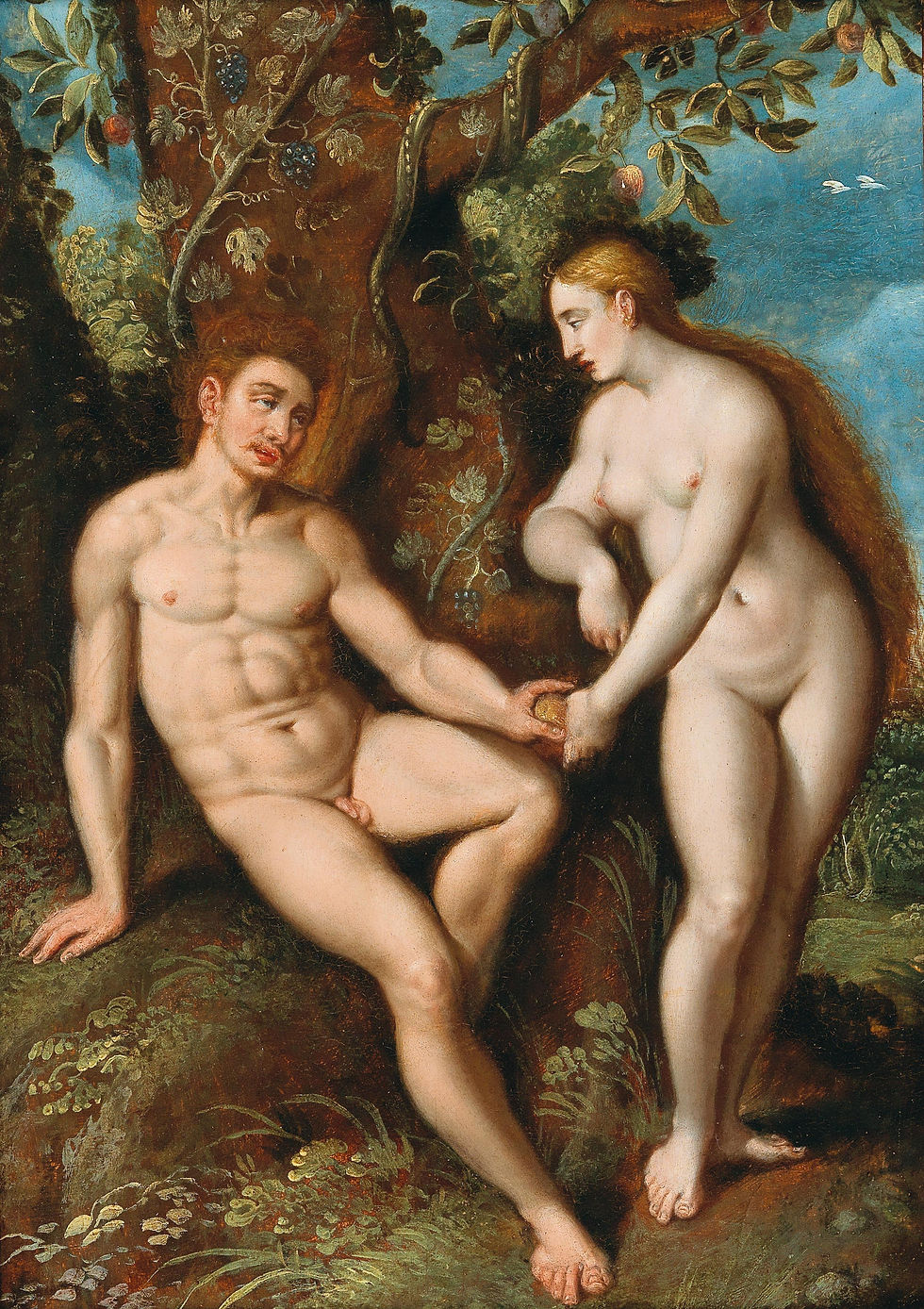
This ordering matters. It suggests that, within the religious imagination, the body is not a problem to be solved but a condition of existence. Shame emerges not because flesh is dangerous, but because relationships – between humans and God, and among humans themselves – have been damaged. But later religious moral systems would increasingly reverse this logic, treating the body as the cause rather than the casualty of moral disorder.
For non-believers, it may be fruitful to think of the rupture between humans and God as an allegory for humanity’s departure from the fundamental imperative to live in harmony with the cosmic creation, through environmental destruction and self-defeating practices. Whatever your starting point – early religious teachings did not cast the human body as shameful, but rather as a perfect creation in the image of God.
Judaism: Nakedness Without Sexual Panic
In Jewish tradition, the body is created good, finite, and worthy of care. Rabbinic law contains extensive discussions of modesty (tzniut), but these are contextual, relational, and social – not metaphysical condemnations of the body itself. Importantly, children’s bodies are not treated as sexually charged. Rabbinic texts consistently assume childhood nakedness as ordinary, especially within families and communal settings, without moral alarm.
Classical Jewish law focuses not on exposure as such, but on humiliation, exploitation, and intentional arousal (Babylonian Talmud, Berakhot; Ketubot). The moral violation lies in degrading another person or using their body as an object, not in the mere visibility of flesh.
This distinction – between bodily presence and sexual intent – was once taken for granted. Its erosion is a modern development, not an ancient command.
Christianity: Incarnation Against Body-Hatred
Christianity inherits Judaism’s affirmation of embodied life but intensifies it through the doctrine of the Incarnation. God does not merely permit the body; God becomes flesh (sarx). Jesus is born naked, nursed, bathed, circumcised, and ultimately executed in a state of public bodily exposure. These facts are not incidental. They are theological claims.

Early Christianity developed in explicit opposition to Gnostic movements that viewed the body as corrupt or illusory. To deny the goodness of flesh was, for early Christians, a heresy. Salvation was not escape from embodiment, but its redemption (Irenaeus, Against Heresies).
Children occupy a particularly revealing place in Christian teaching. Jesus repeatedly elevates them as moral exemplars: “Unless you become like children, you will never enter the kingdom of heaven” (Matthew 18:3). Childhood innocence is associated with openness, trust, and lack of duplicity – not sexual danger. Nowhere in the Gospels are children’s bodies treated as morally suspect or in need of concealment.

The later Christian fixation on bodily modesty, especially regarding children, reflects not early theology but evolving social fears.
Islam: Modesty as Discipline, Not Erasure
Islamic traditions likewise distinguish between nakedness and sexual impropriety. The concept of awrah – the parts of the body to be covered – varies by context, age, and social setting. Classical Islamic jurisprudence explicitly exempts children from sexualized modesty rules, recognizing that desire is not inherent to the body but arises through intention and gaze (Qur’an 24:30–31; classical tafsir).

Notably, Islamic societies historically maintained communal bathing traditions (hammams) where nakedness was ordinary and regulated by custom rather than panic. Moral responsibility focused on self-restraint – lowering one’s gaze, governing desire – not on eliminating bodies from view.

For over a millennium, Islamic societies maintained these communal bathing traditions in which nudity was ordinary, regulated, and non-sexual – a distinction largely lost in modern cultures of fear. Islamic modesty disciplines perception. It does not declare the human form obscene.
Other Traditions: The Body as Fact, Not Threat
Beyond the Abrahamic traditions, similar patterns emerge. In Hinduism, ritual bathing and ascetic nudity coexist within a cosmology that treats the body as both transient and real. Buddhism approaches the body as impermanent rather than sinful, emphasizing mindfulness rather than concealment. Many Indigenous traditions treat nakedness as relational and situational, embedded in kinship and environment rather than morality.

Across these traditions, what is striking is not uniformity, but the absence of automatic sexualization. The idea that a visible body – especially a child’s body – is inherently dangerous is culturally specific, not religiously universal.
Children, Innocence, and the Collapse of Moral Imagination
This brings us to the modern moral inversion identified in Constructing Shame. When societies insist that children’s nudity must be hidden because it is dangerous, they do not protect innocence – they redefine it out of existence. Childhood becomes a state of permanent vulnerability, and adults are cast as ever-present threats.

Religious traditions did not begin with this assumption. They treated children as non-sexual beings precisely because sexuality was understood as contextual, developmental, and relational. To deny this is to project adult anxiety onto children’s bodies, collapsing the distinction between innocence and desire.
This collapse does not arise from deeper moral insight. It arises from fear.
Religion After Fear
The religious imagination once knew how to live with bodies – adult and child alike – without turning them into problems. Shame was not the starting point; it was the warning sign. Where shame dominates, trust erodes. Where trust erodes, moral formation fails.
Recovering older religious understandings of nakedness does not require abandoning modesty, boundaries, or care. It requires restoring context, judgment, and human presence. Morality, as Principle 5 insists, exists to preserve life – not to sacrifice it to abstraction.
Of course, if you are not a person of faith, all of this may seem irrelevant – if you think God is a human invention, then why bother paying attention to what various religions have said about the human body at all? Well, it still matters because whether we like it or not, billions of people around the world adhere to one of the major religions. Simply dismissing their faith as “irrational” and “backwards” is not productive, nor respectful to the very serious efforts to understand the mysteries of the Cosmos made by theologians throughout history.
In this Community, we believe in the imperative to maintain humility when faced with people’s earnestly held beliefs. We believe that we are all speaking about the same force of creation, whether we call it “God” or the “Cosmos.” The key to uniting humanity and bring about global harmony is to help people lift the veil of social construction and distinguish between norms that exist to serve humanity’s goal of self-preservation, and norms that have been created by humans for the purpose of social control.
In that endeavor, understanding that religion stems from efforts to explain and understand that which we do not know (and, perhaps, cannot understand with our limited human cognitive capacities) is crucial.
Imagine what it would do for our ability to communicate across religious divides if we recognized the political and social processes that have taken early religious teachings and turned them into tools of social control. Imagine how many people of faith, currently being made to feel guilt and shame for their bodies and their natural feelings, would feel liberated if they knew that even from a perspective of religion, the body was never the enemy. The loss of interpretive capacity was.
Human liberation from harmful social norms – whether justified through religion or imagined threats – is, ultimately, the mission of the Community of the Cosmic Divine.


Comments