
Constructing Shame: The Evolution of Public Nudity Attitudes in 20th Century America
- AT

- Jan 4
- 7 min read
While nudity among adults of opposite sexes has, at varying levels, throughout history been perceived as bringing about a sexual risk, the nudity of children has historically and universally been understood as non-sexual and “safe.” In much of the world, this is still largely true – social norms around the world are generally accepting of children below the age of sexual maturity being naked in certain public contexts.
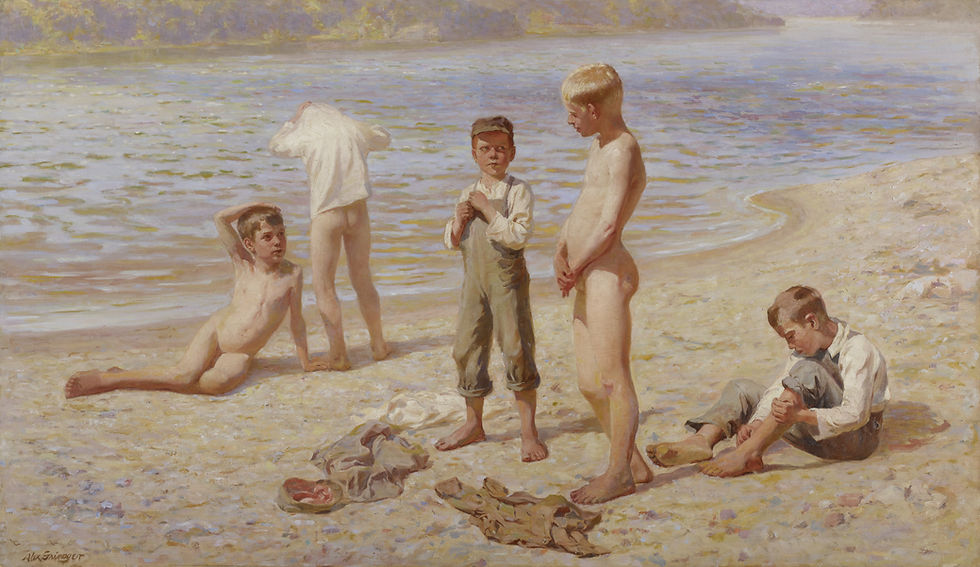
Once upon a time this was also true in America – children were free to bathe naked in its grand rivers and beautiful creeks, and public bathing and communal showers were understood as perfectly normal events. This is decidedly no longer the case – even for adults of the same sex.
From Natural to “Obscene” – The Making of American Gymnophobia
In contemporary United States of America, the naked body is broadly considered automatically sexual. And because it is considered sexual, it must be hidden from view at all times, even from members of the same sex. Consequently, American locker rooms and public showers are now commonly designed as single stalls with dividing walls and a curtain, as opposed to the large open room with multiple showers that used to be commonplace.
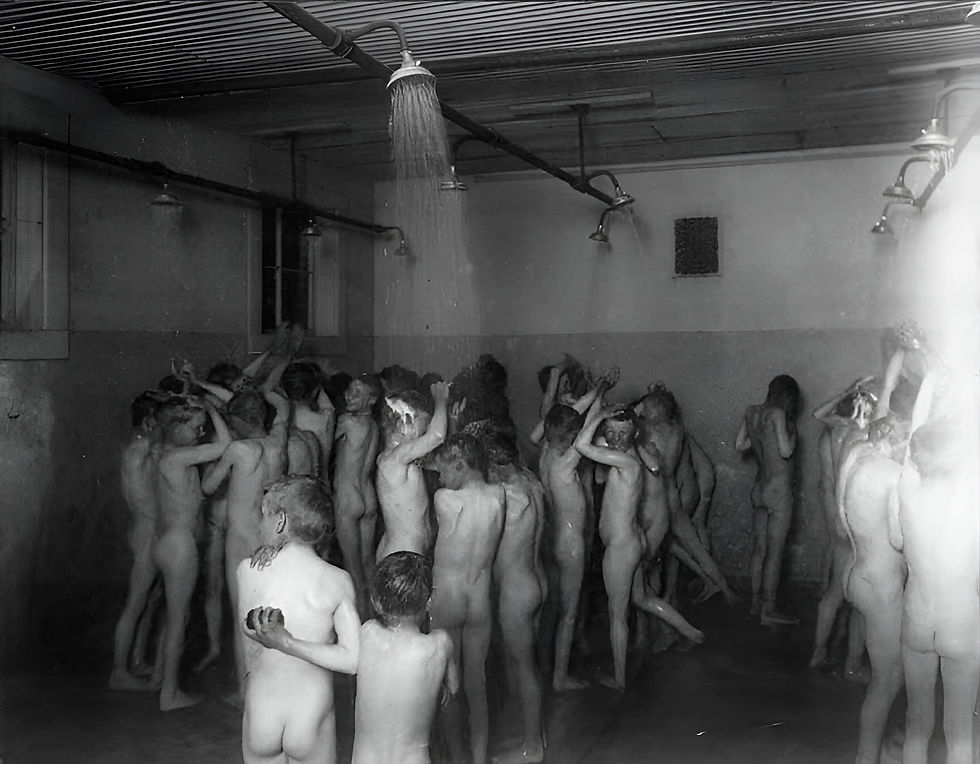
This hypersensitivity to nudity is quite recent, only a couple of decades old. Not long ago, same-sex nudity was fully acceptable, and children could play and bathe naked even in public settings. Today, the scene of scores of naked boys splashing in a public city pool is unthinkable. This article traces the evolution of American gymnophobia – the fear of being naked in front of others and seeing others naked. When did the naked human body become a source of shame in the American society? What explains the sexualization of our most natural state as humans, and the complete erasure of non-sexual nudity as a concept?


A Story of Ideologically Different But Structurally Similar Movements
The story is not as simple as one might think – after all, it was Puritan settlers who colonized America and it is not unreasonable to think that the religious dogma they brought also produced a gymnophobic society. But the fact that this is a more recent phenomenon suggests that cannot be the full explanation.
Understanding why gymnophobia is virtually endemic to American society requires tracing a complex evolution spanning a century and a half. The erasure of non-sexual nudity in the United States was not the result of a single moral awakening, but of successive and overlapping social movements – religious, political, feminist, and therapeutic – that each reduced tolerance for ambiguity. Over time, they replaced contextual judgment with categorical suspicion. Nudity became sexual not because Americans desired it to be, but because no other meanings were left standing – Americans are socialized into thinking non-sexual nudity does not exist.
Moreover, the American story of gymnophobia begins not with a fear of sexual interaction between adults of the opposite sex, but rather with children, who are biologically non-sexual, yet culturally become hyper-sexualized through adult fear. Older Americans may recall swimming naked in the creek by their house or even being naked in the pool in Physical Education (PE) class.

They certainly remember being required to shower after PE class, which is a practice current cultural norms have abolished. In the United States, the practice of requiring elementary school children to shower after PE class largely faded between the late 1970s and the early 1990s. By the year 2000, mandatory showering had nearly vanished from public school systems entirely.
The decline of this practice was driven by several cultural and logistical shifts. In the 1990s, increasing concerns over student privacy led to legal challenges. Most notably, in 1994, the ACLU threatened to sue a Pennsylvania school district, arguing that forcing students to be naked in front of classmates violated their right to privacy.
Moreover, educators became more sensitive to issues of body image, bullying, and harassment in locker rooms, leading many districts to abandon mandatory communal undressing. There was also the argument that it was no longer necessary from a hygiene perspective. Historically, mandatory showering was introduced in the early 20th century because many students lacked running water at home; as home hygiene improved, the “public health” necessity for school showers diminished.

It is true that there was a pressing need for the state to provide access to hygiene facilities in the early 20th century, but this shift, and the immediate causal factors mentioned above, did not happen by accident – they emerged because of the existence of a pre-existing anti-nudity normative discourse.
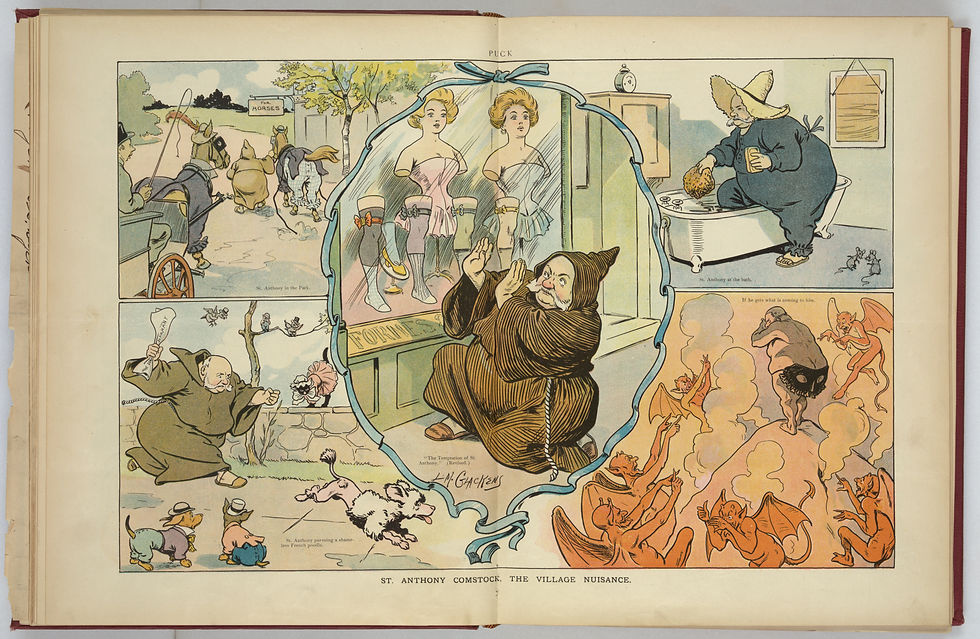
The roots of this discourse can be traced to the Comstock Movement, active from the 1870s to the 1910s. This movement, led by Anthony Comstock and allied Protestant reformers framed “obscenity” as a threat to youth, women, and more broadly national morality. The Comstock Movement used the postal system and federal law to suppress nude imagery, sexual education, and reproductive information. Its key legacy is that it established the idea that the state should police morality proactively, and that exposure to the human body itself was the problem. In America, this moral logic never disappeared; it went dormant and re-emerged later with new language.
The Family as Ideological Weapon
This anti-nudity discourse was not solely produced by grassroots movements – from the 1940s onwards, the US government was an active party in promoting an American lifestyle in stark contrast to that of the Communist Soviet Union and satellites. In the context of the Cold War, from the late 1940s onward, the US government deliberately fused Christianity, patriotism, sexual order, and specific types of family norms. They added “Under God” to the Pledge of Allegiance in 1954, “In God We Trust” to the currency in 1956, and openly promoted churchgoing as a civic virtue, as opposed to a personal choice.

This was state-sponsored moral signaling, not grassroots piety alone. Communism was portrayed as godless, immoral, sexually deviant, sexual restraint and modesty became markers of national loyalty, and the “American family” was positioned as a moral fortress. Nudity, even non-sexual, was increasingly coded as foreign, degenerate, or un-American.
Cold War social movements – often supported by government rhetoric – redefined the nuclear family as sacred, gender roles as natural, and children as symbols of the nation’s future, making children’s bodies politically charged in a new way. Once childhood innocence became nationalized, any bodily exposure could be framed as ideological sabotage.
Protestant Activism Becomes Mass Politics
Once America saw the rise of modern Christian right-wing groups like “Moral Majority,” “Focus on the Family,” and “Concerned Women for America,” sexual conservatism already existed – but they professionalized it. They reframed modesty as child protection, collapsed nudity, pornography, homosexuality, and secularism into a single moral threat, and targeted schools, libraries, public broadcasting, and local ordinances.
They were not just opposing sexual nudity – they were opposing any kind of naked representation of the human body, erasing any attention to the context of nudity, categorically rejecting artistic nudity and familial nudity, along with pornographic nudity.
An Unexpected Ally: Feminist Anti-Pornography Movements
This is where the story gets more complex, as Christian right-wing groups would find overlap in interests with highly unexpected allies in the 1970s and 1980s. Radical feminist activists like Andrea Dworkin and Catharine MacKinnon argued that sexual imagery is inherently exploitative and representation itself constitutes harm, claiming intent and context are irrelevant if power asymmetries exist.
Consequently, though ideologically opposed to the Christian Right, these movements supported censorship, expanded definitions of sexual harm, and rejected distinctions between eroticism and violence. They reinforced the idea that visibility equals injury, further narrowing the space for non-sexual nudity – especially involving women and children.
Institutionalization of Fear and the Erasure of Non-Sexual Nudity
Adding yet another awkward ally, the Child Protection Movement provided the most decisive shift in the 1980s and 1990s. Driven by abuse awareness campaigns, high-profile moral panics, expanding legal liability, and media sensationalism, they produced new norms, casting adults as default risks, children as permanently vulnerable, and exposure as inherently dangerous.
Unlike the earlier religious movements, this one spoke the language of psychology, emphasizing trauma and risk management, which made it nearly unassailable. At this point, nudity didn’t need to be immoral to be unacceptable – it only needed to be risky.
While all these movements differed drastically ideologically, they converged structurally and each built on pre-existing discourse to produce the gymnophobic American society we see today. Through organized effort, they erased the concept of non-sexual nudity from social discourse
American norms around nudity – especially involving children – did not emerge naturally from increased knowledge or moral progress. They were actively constructed by moral entrepreneurs beginning in the late nineteenth century, legally entrenched through obscenity law, and later reinforced by religious, political, feminist, and therapeutic movements.
Over time, these actors eliminated alternative interpretations of the naked body, leaving sexuality and danger as the only culturally legible meanings. The result is not protection, but a collapse of interpretive capacity – one that feels natural only because its construction has been forgotten. Beyond that, it has also lead to a hyper-sexualization of children, who can no longer be innocently unclothed in any context without there being a sexual connotation to their natural state.

This is not a healthy relationship to the human body and it makes all of us, but in particular children, less safe. If norms were made, they can be re-made. But only if we recover the ability to talk about context, intent, and meaning. This involves lifting the veil of social construction, and building a counter-discourse, through which a new “common sense” regarding the naked body can emerge in American society.


As an American, you phrased the observations I've had recently in such a poignant way, and also educated me on how American society got here to this sad paradigm. I will also add that our materialism and consumerism has a role to play in this as well —namely that because even adult nudity is solely viewed as sexual, it is used as a tantalizing (without exposing skin, of course) way to sell many products.
This was such an interesting read - thank you! I had no idea it was such a complex problem, or that Americans once were different. I just assumed this was a natural outcome of the puritan Christian origins of the country. This makes me even more excited for the coming education center - I want to learn more about social construction!